The Bible is filled with amazing stories, parables and historical accounts. There are also some less interesting parts, like genealogies. Perhaps you — like many people — tend to skip right over them. After all, genealogies are dense and filled with Scrabble-winning names like “Amminadab” and “Zerubbabel.” People often don’t realize that genealogies have just as much significance and importance as other passages in Scripture.
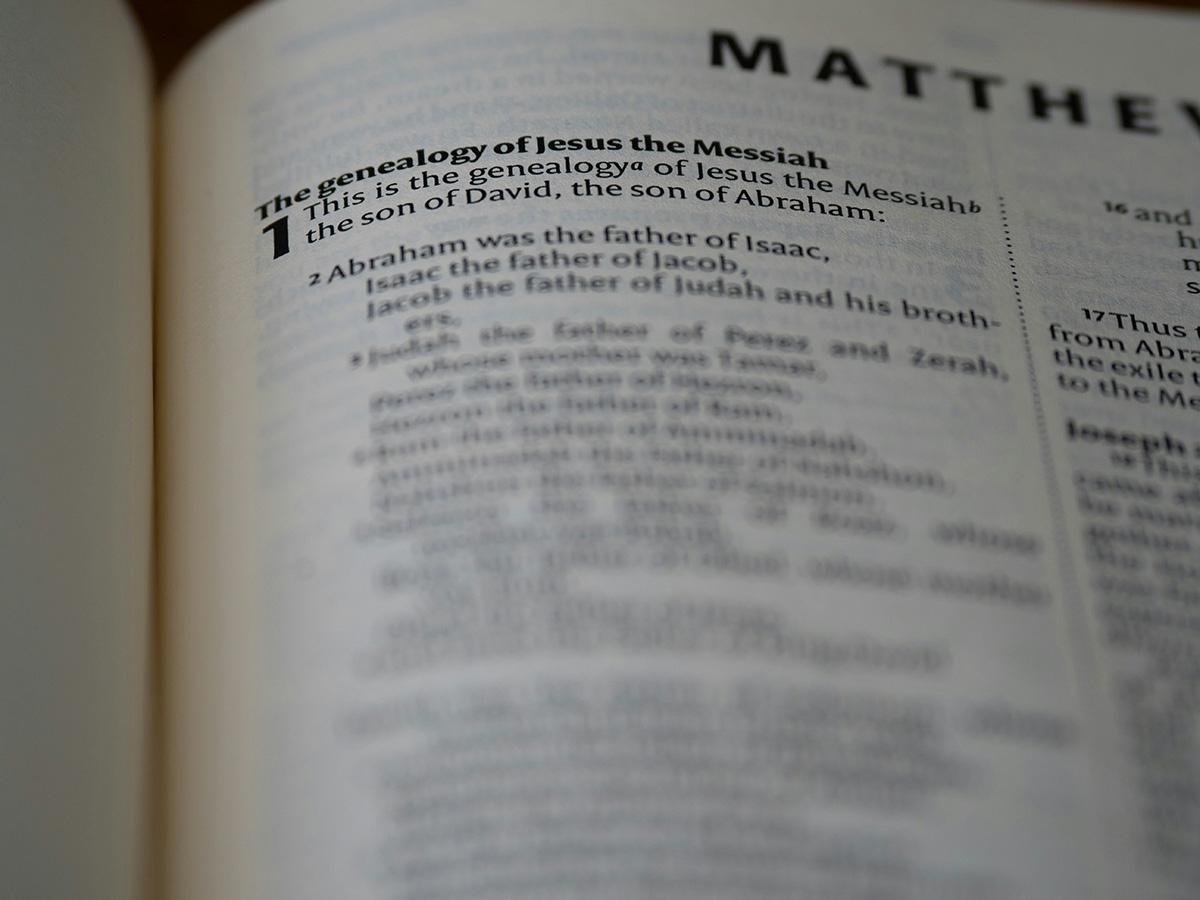
Matthew 1 is a perfect example.
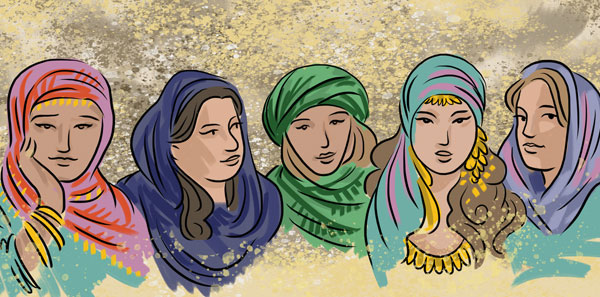
Matthew begins his Gospel with the genealogy of Jesus, tracing His family line through generations of people and connecting Jesus to Abraham and King David. But tucked among all those names is something particularly interesting. Five women appear in Jesus’ family tree: Tamar, Rahab, Ruth, Bathsheba and Mary.
Why are these women included in Jesus’ genealogy? Matthew doesn’t tell us directly the reason he draws attention to them, but their presence is striking. Women were not typically the focus of ancient Jewish genealogies, and each of these women has a story marked by unexpected circumstances.
Some of the women experienced grief or injustice. Others were connected to painful or complicated chapters in Israel’s history. Yet each one became part of the family line that led to Jesus.
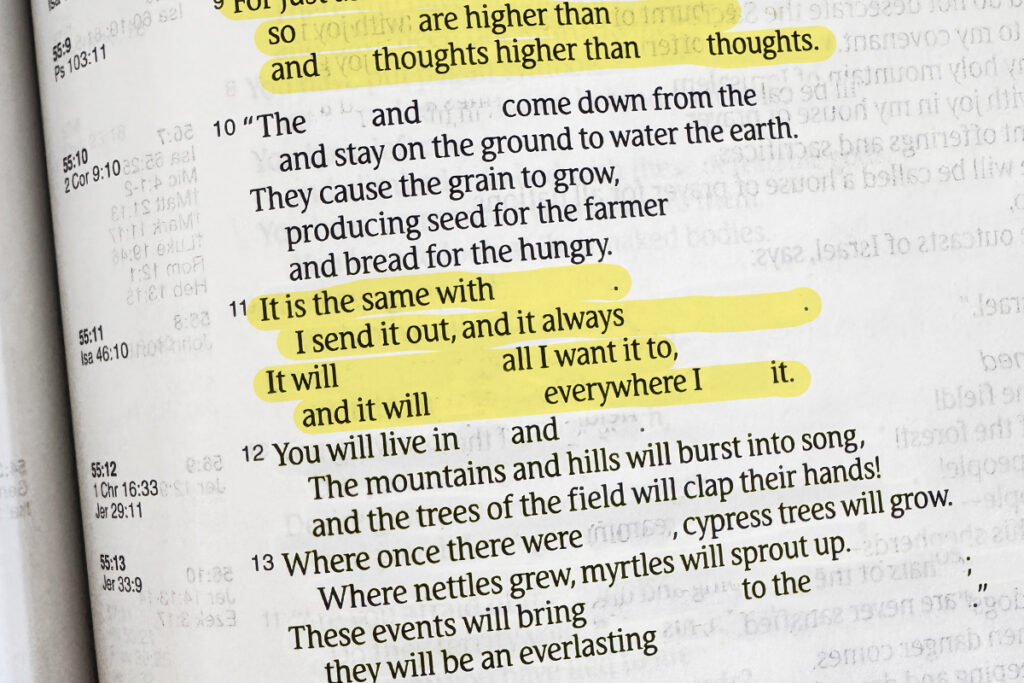
What if you were missing part of the story?
Matthew’s genealogy doesn’t stand on its own. To understand why these names matter and how they point to Jesus, we need the story that came before them. Yet many people around the world are still waiting for access to the whole of Scripture.
See what it might feel like to read Matthew without the full context of God’s Word.
Explore “H ly B bl: Incomplete Scriptures” →
Let’s take a closer look at these five unlikely heroes in Matthew 1 and what their stories reveal about God’s grace, faithfulness and redemption.
Tamar: The Seeker of Justice
Judah … said, “She is more righteous than I am … .”
Tamar’s story is one that would, in our modern time, be branded with a “not appropriate for work” warning. It’s a sordid tale of grief and depravity. And that’s what makes Tamar’s inclusion in the genealogy of Jesus so very interesting. Genesis 38 tells the story of Tamar — she was the daughter-in-law of Judah, a man who had three sons: Er, Onan and Shelah. Tamar married the eldest son, Er, but the man was “a wicked man in the LORD’s sight, so the LORD took his life” (Genesis 38:7, NLT).
In that culture, it was customary for a woman to marry the brother of her deceased husband in order to be provided for and remain a part of the family. Judah married Tamar to his second son, Onan, who was also wicked and put to death by the Lord. At this point, Judah lied to Tamar, promising that she would be taken care of when his youngest son was older. But he had no intention of actually doing so.
Tamar experienced significant loss at the hands of wicked husbands who mistreated her and faced abandonment by Judah. And as we see in her story, this led her to do some questionable things. But it was Tamar’s pursuit of justice in Judah’s abandonment of his promise that allowed her to be a part of Jesus’ family.
But when Judah discovered who Tamar was and what she did to ensure that she would be taken care of — that she would not be dismissed or disparaged — he said, “She is more righteous than I am.”
Tamar’s circumstances and the presence of immorality in her story would have us all believe that she would not be celebrated by Scripture. And yet, Tamar was given the honor of being the first woman included in Jesus’ genealogy. The pain, loss and sin she was subjected to would ultimately be redeemed by the Messiah in her family tree.
Rahab: The Harlot
“God has a people where we little dream of it, and he has chosen ones among a sort of people whom we dare not hope for; who would think that grace could grow in the heart of one who was a harlot by name, as though her sin was openly known to all? Yet it grew there, like a fair flower blooming upon a dunghill, or a bright star glittering on the brow of night! There her faith grew, and brought forth glory to God!”
— Charles Spurgeon
Out of all the people in Jericho, who would suspect that Rahab — the harlot — would be the one to fear the Lord and keep the Israelite spies safe? This woman was unassuming and had nothing to gain from helping the spies. Yet she, out of all of the people in the city, was the one to protect them and to trust in the Lord’s strength.
It can be easy to judge Rahab based on her profession. People are often quick to make assumptions about others based on what they look like, where they live or what they do for work. And yet, Rahab had immense faith in the Lord.
In Joshua 2:11b (NLT), she tells the spies about Jericho’s fear, and ends by saying: “For the LORD your God is the supreme God of the heavens above and the earth below.”
Perhaps that is why Scripture refers to Rahab, throughout, as a “harlot” — because it is demonstrative of the fact that God can redeem anyone and anything for His purpose; that He uses the most unlikely of people to bring about His plans. Because of that faith and display of heroism, Rahab is a part of the lineage of Jesus.
God can redeem anyone and anything for His purpose; He uses the most unlikely of people to bring about His plans.
Her example also points toward the world’s salvation and how it came in the most unexpected form — a baby in a manger.
Ruth: The Sacrificial Servant
But Ruth replied, “Don’t ask me to leave you and turn back. Wherever you go, I will go; wherever you live, I will live. Your people will be my people, and your God will be my God. Wherever you die, I will die, and there I will be buried. May the LORD punish me severely if I allow anything but death to separate us!”
Ruth had the opportunity to rebuild her life. After her husband died, her mother-in-law, Naomi, gave Ruth permission to return to her home and her family. Naomi had no way to provide for her daughter-in-law financially. She had no other sons for her to marry and no husband to provide for them.
If given the choice to return to your family, who would welcome you and comfort you in your grief, would you leave Naomi? Would you reject the possibility of a comfortable life for the uncertainty of a new land, a new people and new customs? Ruth did.
Rather than return to her hometown, Ruth was steadfast in her love for Naomi. She sacrificed a life she knew for one of uncertainty. Naomi couldn’t promise Ruth a comfortable future with a husband or financial security. But still, Ruth went with her. She remained faithful to Naomi and also pledged her faithfulness to the Lord.
Because of that faithfulness, Ruth was ultimately blessed with a husband named Boaz (and together they had a child named Obed, whose son was Jesse — the father of King David).
Ruth couldn’t have known that by following Naomi she would someday be blessed by being a part of the Messiah’s family. As Hebrews 11:1 (NLT) states, “Faith shows the reality of what we hope for; it is the evidence of things we cannot see.”
How often do you practice the kind of faith Ruth had?
Bathsheba: The Wife of Someone Else
“She is Bathsheba, the daughter of Eliam and the wife of Uriah the Hittite.”
There’s a good chance that you know the story of David and Bathsheba. You probably know that David’s act of adultery ended with the death of Uriah, David’s faithful warrior — and more importantly, Bathsheba’s husband.
If you read through Matthew 1, then it is interesting that Matthew associates Bathsheba with Uriah (“David was the father of Solomon, whose mother had been Uriah’s wife” — Matthew 1:6b, NIV). It seems that whenever Bathsheba is mentioned, so is David’s sin.
We don’t know much about Bathsheba, but she could not have known that she would become a part of the lineage of the Messiah — even if it was because of circumstances outside of her control.
Bathsheba was a faithful wife who caught the eye of a king. In this culture, she had no choice but to obey David, even if she was already married.
Bathsheba was resilient in the face of multiple accounts of grief — when she lost her husband and when she lost her child. Bathsheba is a woman who was initially sought out as the object of David’s desire, but who showed persistence and perseverance and a spirit not defined by her circumstances.
Faith is often a result of ordinary people obeying God in spite of their circumstances.
We can learn from Bathsheba that faith is often a result of ordinary people obeying God in spite of their circumstances. Her story is a reminder that life does not always go according to plan. Unexpected circumstances will arise, but God is constantly and sovereignly working through them to bring about plans bigger than anyone can imagine.
Mary: The Unlikely Girl
“For [God] took notice of his lowly servant girl, and from now on all generations will call me blessed.”
A virgin girl was chosen to be the mother of the Savior of the world.
It doesn’t get any more unlikely than that.
Mary’s story is incredible. She was betrothed to someone when the angel of the Lord told her she would become the mother of the Messiah. As such, she likely faced daily shame and scorn for what others assumed about her.
She was probably scared and uncertain of her future, and yet she expressed an ultimate faith in God who always made and delivered on His promises. When the angel appears to Mary, her response is an indication of her faith: “Mary responded, ‘I am the Lord’s servant. May everything you have said about me come true’” (Luke 1:38a, NLT).
Mary recognized her unlikeliness, singing out praises to God: “For [God] took notice of his lowly servant girl, and from now on all generations will call me blessed” (Luke 1:48, NLT).
Mary was an ordinary girl who likely planned to live an ordinary life. But this story holds a beautiful reminder that God never sees anyone as “ordinary.” The world considered Mary to be an unlikely girl on the threshold of marriage. But God rewarded her faith and planned from the very beginning for her life to be anything but ordinary.
What an unexpected thing, for the Messiah to come from a lineage of broken people with broken stories, and ultimately be given life by a virgin girl who was favored by God.
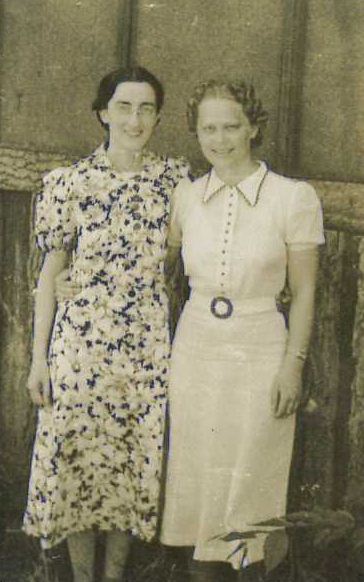
The unlikely heroes in Jesus’ genealogy are part of a much bigger story of God working through ordinary people for His purposes. Meet Florrie Hansen and Eunice Pike, two pioneering women whose faith and willingness to follow God helped shape the history of Bible translation.
What the Women in Jesus’ Genealogy Show Us
Tamar, Rahab, Ruth, Bathsheba and Mary are unlikely people to be included in Jesus’ lineage. Some are young. Some are widows. Some are tied to people who have committed sinful acts. But their stories are all about grace.
Matthew 1 does not give us a polished family history filled only with kings, heroes and people whose lives unfolded exactly as expected. It shows us a real family — one that includes faith and failure, grief and redemption, outsiders and kings.
And through every generation, God remained faithful to His promise to bring about a Savior.
Everything about Jesus was unlikely. He was born to an unlikely woman, grew up in an unlikely place (“Nazareth … can anything good come from Nazareth?” — John 1:46, NLT).
Jesus grew up as a normal child, became a carpenter and led as a servant rather than the kind of earthly king many expected. The disciples assumed the Messiah would be a great ruler, a politician or a royal figure to save them. But as the Savior, Jesus was none of those things.
His family tree includes five notable women whose stories probably would not have fit anyone’s expectations for the lineage of the Messiah. God was at work in each of their lives, using their faith, courage and obedience as part of the plan He had been unfolding across generations to bring Jesus into the world.
The women of Matthew 1 remind us that God can work through unlikely people and unexpected circumstances to accomplish His purposes.
How might God use unlikely circumstances in your life to bring about His plans and purpose?